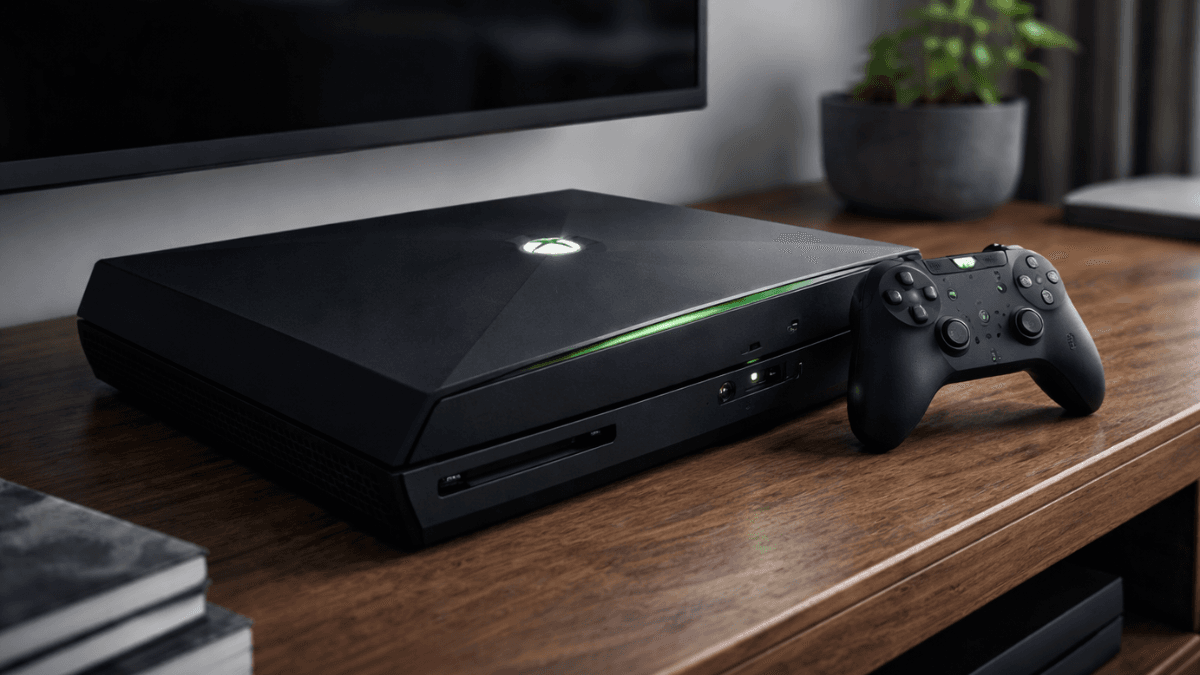
I made a throwaway post the other day. Pretty simple. It said: if the next-gen Xbox hardware project Helix ships without a disc drive, it will be dead on arrival.
It resonated with a lot of people. And that told me something.
Not that my take was some brilliant revelation, but that a nerve is exposed right now in gaming. People feel it. Something is off. And it’s not one thing. It’s a slow accumulation of decisions being made above our heads that are reshaping what it means to be a gamer, and not in ways most of us asked for.
So I want to talk about what’s broken, why disc drives actually matter, and what I think we should be demanding from the companies that steward this industry. Consider this an open letter. I know there are devs and decision-makers who will see this. I hope they’re listening.
The MVP Problem
Here is what’s happening now: games ship in what I’m calling MVP state. Minimum viable product. It works. Is it complete? No. Is it the writers’ and developers’ vision for what this game was supposed to be? Not even close.
It used to be that patches were the exception. Something slipped past testing, and a fix came through. That was fine. Now the patch is the product. The game you buy on day one is a rough draft. Maybe a year later it becomes what it was always supposed to be. But by then, most of the player base has moved on.
If Resident Evil gets a substantial overhaul six months after launch, it could be years before I come back and see what changed. I already finished the game. That moment is gone. And instead of this being the exception, it’s become the standard.
Ownership Is Becoming a Memory
We are being asked to rent more and more of our lives from companies. Everything is temporary. Everything is fleeting.
Let’s say you’ve been on Game Pass for two or three years. You’re enjoying it. Then something happens. Life happens. You need to step away from that subscription for a while. You pause it, and you realize your console doesn’t do anything anymore. There is nothing on it that you can play, because you were renting the entire time.
Those of us who grew up in the 80s and 90s understand what it means to walk over to a shelf, grab a cartridge or a disc, and just play. No authentication. No server check. No subscription status. Just you and the game. That ability is disappearing, and most people won’t realize what they lost until it’s gone.
When you buy a digital game, you’re not really buying the game. You’re buying permission to access it. That permission can vanish. The store shuts down. The license expires. Your account gets banned. A publisher just pulls the game. We have already seen all of these things happen.
The Identity Crisis
There’s another layer to this that doesn’t get enough attention: console identity is evaporating.
Think about what each platform used to mean. Nintendo has always challenged itself to make the hardware part of the experience. NES to Super Nintendo was a massive leap. The Wii introduced an entirely new way to play. Every time we saw a weird controller and thought “what are they thinking,” it ended up feeling natural in our hands. Nintendo has identity in its characters, in Mario, Metroid, Zelda, Kirby, but also in the way their games feel to play.
PlayStation came out swinging as the more mature alternative. Xbox picked up where Sega left off, the arcade DNA, the online-first mentality, and then built its own pillars with Halo, Gears of War, and Fable. These were games designed for that controller, best played on that hardware, at home on that platform.
Somewhere along the way, those lines blurred. Now we’re going to see Halo on PlayStation. And look, I hear the argument. Accessibility is good. Not everyone can afford multiple expensive consoles. That’s valid. But the more you do that, the more you have to answer the question: what’s the point?
If Microsoft wants to be a third-party publisher, then they should commit to that. If they believe they’re a software company that delivers software best, that’s a legitimate path. But then what is Helix? What is it for?
Why Disc Drives Actually Matter
If we remove physical media from gaming, we lose three things: ownership, preservation, and choice.
I’ve already talked about ownership. But preservation might be the most important one, and it’s the one most people won’t think about until it’s too late.
Gaming history is disappearing faster than ever. When servers shut down, when storefronts close, when publishers go offline and rights get tangled up in corporate mergers, games simply vanish. Digital-only accelerates that. A disc is the closest thing we have to a permanent record. Twenty years from now, you can still plug in a retro console and play those games. The rights may have changed hands a dozen times, but the disc still works.
And then there’s backwards compatibility. Microsoft has actually been great about this, investing real money in making older games playable on newer hardware. They made that promise to us. So why would they ship a console that can’t read the discs those older games are on? If they don’t include a disc drive, what happens to that entire library?
Now, I want to address a couple of things that came up in the conversation.
“Discs are too small and too slow.” Agreed. I’m not saying games should read off the disc in real time. I’m saying the install files should be on the disc. You install from the disc to your system. If you need to delete it later to make room, fine. But you still have the disc. You can always reinstall. Multiple discs solve the capacity problem. We’ve done it before.
“PC gaming doesn’t use discs and PC gaming is fine.” True. But PC gaming is fundamentally different. It’s an open platform. You can mod games, maintain independent patch archives, access files directly, and choose from multiple storefronts and launchers. Console gaming doesn’t work that way. Consoles are closed ecosystems, and that’s exactly why physical media matters more on console than it does on PC.
The GOG Model Shows Us a Better Way
A lot of people brought up GOG, Good Old Games, and they were right to. GOG is proof that digital ownership can work when a company actually wants it to.
GOG sells games without DRM. You download the full install file. You can run it without the GOG launcher. You can back it up to a hard drive or any archive you want. It runs offline forever. Even if GOG disappears tomorrow, that file you purchased is yours.
Compare that to Steam, where your library is tied to your account, most games require authentication, and offline play comes with caveats that basically amount to “it might not work.” And the same applies to the digital storefronts on Nintendo, Sony, and Microsoft. What happens if your account gets banned and you’ve sunk thousands of dollars into that library? What do you do?
Microsoft is the largest developer and publisher on the planet. They could implement the GOG model tomorrow. They could give you true ownership over your digital purchases. They are choosing not to. That should tell you something about where their priorities are.
From Behind the Counter
I want to share something from the CastleMania perspective, because we’ve seen this from a side most people don’t.
Several years ago, we were offering new games at launch, day and date with every major retailer. We could do that because we had a relationship with a company called Ingram Entertainment. Most people have never heard of Ingram, but they were the largest U.S. distributor for physical media: games, movies, music. They supplied CastleMania Games. They supplied Best Buy, Walmart, Target. If you bought a physical game in America, odds are it came through Ingram.
In September 2023, Ingram announced they were shutting down distribution. Costs were exceeding sales. They gave the industry a year’s notice and wound down operations.
Here’s what that looked like on our end. A game retailed for $59.99. Our cost was something like $52.70. Amazon was shipping these things for free to Prime members. Big box stores had foot traffic and impulse buys to offset thin margins. For an e-commerce store like ours, it was often a loss leader. You carried new releases so people would find your store and maybe buy something else while they were there.
Was that sustainable? Not really. And that brings up an uncomfortable question.
Games cost $60 in the 90s. They still cost $60 in the early 2020s. An all-digital future never brought the price down for consumers, but was it quietly subsidizing what should have been a price increase on the physical side? Maybe. The economics were breaking long before Ingram pulled the plug.
But here’s the other side of that coin. Are these companies actively making it harder to release games physically? The minimum order quantities tell a story. Common knowledge in the industry is that Microsoft’s MOQ sits around 10,000 units while Sony’s was closer to 3,000. That’s a big gap, and it’s one reason companies like Limited Run started exclusively with PlayStation. Sony was simply more friendly to physical publishing.
What Digital Gets Right
I want to be fair. Digital distribution has done genuinely good things for gaming.
It demolished the barrier to entry for independent developers. Games like Stardew Valley and Shovel Knight broke through in an environment where physical publishing would have been cost-prohibitive. They went direct to the customer, and their games stood on their own merits. That matters enormously.
Digital also means worldwide access on launch day. It doesn’t matter what country you live in. That wasn’t always true when we were shipping physical product around the globe.
Is an all-digital future inevitable? Possibly. Can we do it better than we’re doing it now? Absolutely.
A Gamer’s Bill of Rights
So here’s what I’m proposing. Call it a Gamer’s Bill of Rights. Maybe that’s a dramatic name, but these are principles that the people stewarding modern gaming should get behind.
Ship complete games. Not MVPs. Not roadmaps. The game should be finished on launch day.
Put the game on the disc. The full install files. Not a download key. Not a launcher redirect. A game that is playable offline, today and in the future. If there’s a campaign, it goes on the disc.
Respect the purchase. We should own the version of the game we bought. If it changes after the fact, we should have access to the original. Version control isn’t a radical concept. The software industry figured this out decades ago.
Allow preservation. Let us back up and archive patches. Let us maintain access to the version of the game we feel is best for us as the consumer.
No forced online for single-player games. This one is simple. If I’m playing alone, I should not need an internet connection. Full stop.
Don’t build games around monetization. Microtransactions should not shape gameplay design. That model belongs on mobile. Keep it off the console.
Move beyond “everything is an Xbox.” We don’t want thin clients that are just login portals. We want consoles with purpose, with identity, with a reason to exist beyond running the same software as every other screen in the house.
Invest in daring stories. Studios are less willing to take risks when everything is expensive and everything has to make money. But the best games, the ones people remember for decades, were the ones that challenged conventions. Give creators the room to do that. Have a program, a green light initiative, something that says we believe in this even if it’s not a guaranteed blockbuster.
This is the start of a conversation, not the end of one. I want to hear from you. What am I missing? What are you seeing? What matters to you?
Because the people making these decisions need to hear it. Not from me. From all of us.
Welcome to the Castle.